These machines were made for everyday life in Japan. Their power ratings tell a small part of that story—and explain the name of this collection.
100V
The household standard.
Ordinary household outlets in Japan generally supply 100 volts of alternating current (AC). Some appliances use dedicated 200 V supplies. Every machine in this collection is a 100 V model made for the Japanese domestic market.
50 / 60Hz
The rhythm of the current.
AC repeats in cycles. Frequency, measured in hertz (Hz), is the number of cycles each second: 50 Hz means 50 cycles; 60 Hz means 60. Japan uses both. The voltage at an ordinary household outlet is still 100 V in either region.
01 / THE REGIONAL DIVIDE日本の電源周波数
A different rhythm, east and west.
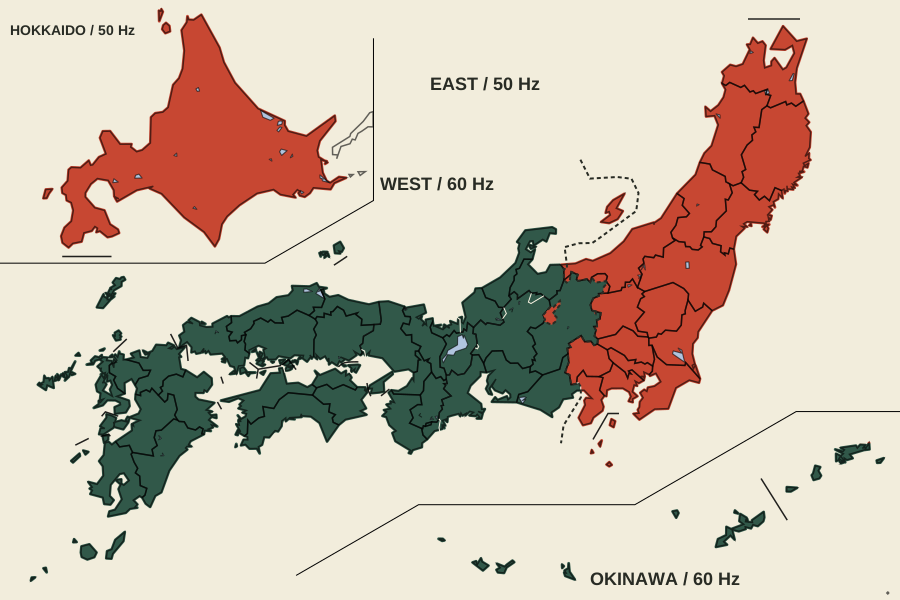
50 Hz Eastern Japan60 Hz Western Japan
Hokkaido is inset at upper left; Okinawa and southern islands are inset at lower right. Dashed lines mark the frequency divide. Enlarge & zoom ↗
50 Hz / EASTHokkaido, the Tohoku region and Tokyo are on the 50 Hz side.
60 Hz / WESTNagoya, Kyoto, Osaka, Shikoku, Kyushu and Okinawa are on the 60 Hz side.
The divide runs through central Japan, roughly between Itoigawa in Niigata Prefecture and the Fujigawa River in Shizuoka Prefecture. It does not simply follow prefectural borders; there are local exceptions. The map is a regional reference, not a substitute for checking an individual machine’s rating.
02 / HOW IT BEGAN
Two beginnings. One lasting detail.
The split dates to the early days of Japan’s electricity industry. The Kanto region introduced German 50 Hz generators, while the Kansai region introduced American 60 Hz generators. Those different beginnings left a distinction that remains today.
03 / READING THE RATING PLATE
A small label. A meaningful difference.
For an amplifier designed for both 50 and 60 Hz, the regional frequency difference does not change its specified audio power output. The supply frequency is separate from the frequencies in the music: it does not set the pitch or playback speed of an amplifier’s audio signal.
AMPLIFIERS / AUDIO OUTPUT
A 50/60 Hz amplifier has the same specified audio output on either supply frequency, at its rated voltage. The correct supply voltage still matters, and the machine’s rating plate identifies the frequencies it supports.
CLOCKS / MOTOR SPEED
In clocks that use a mains-synchronous motor, the supply frequency sets the motor’s speed and therefore the rate of timekeeping. Some turntables and tape decks also use motors whose speed depends on the mains frequency. Quartz-controlled and electronically regulated designs work differently.
ILLUSTRATIVE RATING / NOT A SPECIFICATION FOR EVERY MACHINEAC 100 V · 50/60 Hz
100 V identifies the supply voltage. 50/60 Hz indicates operation at either frequency, subject to the manufacturer’s instructions.
A conventional step-down transformer can reduce voltage to 100 V, but it does not change 50 Hz into 60 Hz, or the reverse. For a vintage clock or any other machine, the voltage and frequency markings—and the original manual—both matter.